
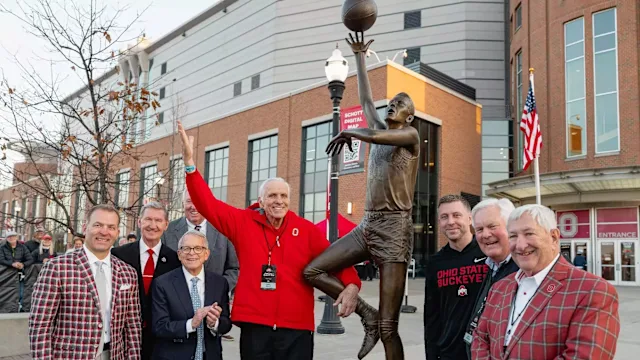
Statues don’t just decorate a campus, they tell a story.
At Ohio State University, that story is being rewritten right now.
Following the recent unveiling of a statue honoring basketball legend Jerry Lucas, a wave of conversation is sweeping through Buckeye Nation: Who deserves to be immortalized next? And more importantly, what values should the university celebrate as it builds its next generation of heroes?
This isn’t simply about honoring athletes.
It’s about defining identity, preserving history, and shaping what future generations of students and fans will see as the pillars of Ohio State’s athletic spirit.
And according to a recent feature by Land-Grant Holy Land, two names are leading the conversation:
James Laurinaitis and Katie Smith, two icons from different sports, different eras, and equally powerful legacies.
Why Statues Matter More Than Ever
Statues may appear symbolic, but in the world of college sports, symbolism is everything.
A statue says:
This person shaped who we are.
This person stood for something bigger than wins.
This person represents excellence we want to preserve.
In a time when college athletics are evolving, NIL deals, conference realignments, rising visibility for women’s sports, the question of “Who gets honored?” has become deeply meaningful.
Ohio State is one of the most decorated athletic programs in the nation, but not everyone who shaped that legacy has been recognized equally. The new conversations reflect a powerful cultural shift: expanding the definition of excellence beyond traditional male-dominated sports.
Which brings us to the two athletes at the center of the debate.
James Laurinaitis: A Buckeye Leader On and Off the Field
James Laurinaitis isn’t just a former linebacker, he’s one of the most respected figures to ever wear scarlet and gray.
As a player, he was:
- A three-time All-American
- Winner of the Butkus Award (best linebacker in the nation)
- Winner of the Nagurski Trophy
- A fierce leader on a defense known across the country for its dominance
Laurinaitis wasn’t simply talented, he was consistent, disciplined, and deeply committed. His presence shaped an era of Ohio State football defined by toughness and unity.
And now, as a coach, his influence has only grown.
He’s returned to Columbus to help mentor the next generation of linebackers, connecting past glory to future promise. That kind of full-circle loyalty is rare in modern sports.
For many fans, a statue of Laurinaitis would represent:
- The sustained excellence of the football program
- The leadership culture he embodied
- The enduring bond between alumni and the university
In a school where football is a cultural heartbeat, Laurinaitis stands as a symbol of what it means to be a Buckeye both on and off the field.

Katie Smith: The Era-Defining Pioneer Who Changed the Game
If James Laurinaitis represents Ohio State’s football identity, Katie Smith represents the rise, power, and excellence of women’s athletics.
Katie Smith is not just a Buckeye legend, she is one of the greatest women’s basketball players in the world.
Her career includes:
- Three Olympic gold medals
- A WNBA championship
- Being named one of the Top 20 WNBA Players of All Time
- Ohio State’s all-time leading scorer (men or women)
- A groundbreaking legacy that inspired generations of young athletes
What makes Smith so significant isn’t just her list of achievements, it’s the era she helped build. She competed at a time when women’s sports were fighting for visibility, recognition, and respect. Her excellence pushed the conversation forward.
A statue of Katie Smith at Ohio State would be more than a tribute.
It would be a statement.
A statement that:
- Women’s athletic achievements are not secondary, they are central
- Excellence is honored regardless of sport or gender
- The university is committed to elevating women’s history, not just preserving it
In an era where women’s sports are booming, from the WNBA’s rise to college basketball viewership records, celebrating Katie Smith would align Ohio State with the future, not the past.
A New Era of Recognition: What This Movement Represents
The conversation around statues at Ohio State isn’t just about two athletes. It reflects a larger cultural shift in how universities celebrate legacy.
Here’s what’s driving it:
1. A Growing Emphasis on Women’s Sports
Fans, media, and institutions are giving women’s athletics the respect they’ve long deserved. Statues reinforce this momentum.
2. A Reconsideration of “Who Gets Remembered”
Instead of limiting memorials to football and men’s basketball, universities are expanding their definition of greatness.
3. Athletes Who Shape Identity Beyond Competition
Coaches, mentors, community figures, advocates, schools are acknowledging the impact athletes have beyond wins and losses.
4. The Power of Representation
Future athletes should see themselves reflected in the honors displayed around campus. Representation inspires participation, pride, and possibility.
Ohio State is not just asking who was great, it’s asking who shaped who we are?
So… Who Should Get the Next Statue?
There is no wrong answer between Laurinaitis and Smith, only powerful stories worth celebrating.
- Laurinaitis stands for leadership, loyalty, and football excellence.
- Smith symbolizes trailblazing, transformation, and the elevation of women’s sports.
Both shaped Ohio State’s history.
Both represent pillars of Buckeye pride.
Both deserve recognition.
In a perfect world?
Ohio State would build both statues, one honoring the past leadership of football, and one honoring the pioneering greatness of women’s basketball.
Because true excellence isn’t either-or.
It’s yes, both.
The Future of Buckeye Legacy
Statues may be made of bronze, but the stories behind them are alive. They inspire. They teach. They remind us of the power of dedication and the impact of greatness.
As Ohio State decides who to honor next, one thing is clear:
This is more than a statue debate. It’s a cultural moment. A chance to define what excellence means in 2025 and beyond.
Buckeye Nation isn’t just remembering history.
It’s shaping the future of it.


 Move Elevate
Leave a comment